Upcoming: March Colloquium with Lina Franken
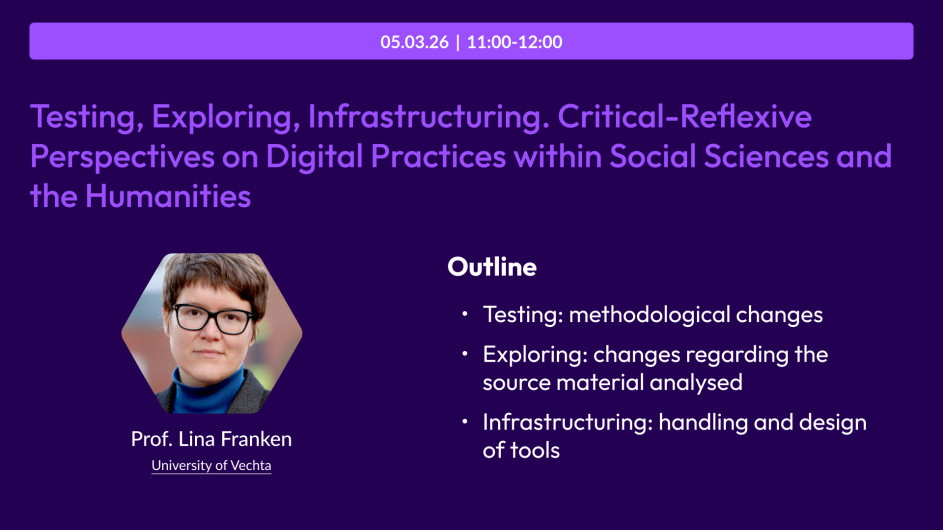
Join us for the next Interdisciplinary Colloquium on Digitalisation of Research! This time we're meeting on 5th March at 11:00. Our special guest will be Lina Franken, Professor of Digital Humanities, University of Vechta, who will give a talk on "Testing, Exploring, Infrastructuring. Critical-Reflexive Perspectives on Digital Practices within Social Sciences and the Humanities". This talk will sketch how digital practices are transforming research in the Social Sciences and Humanities, with growing emphasis on modelling, operationalizing research steps, and structuring data across new scales.
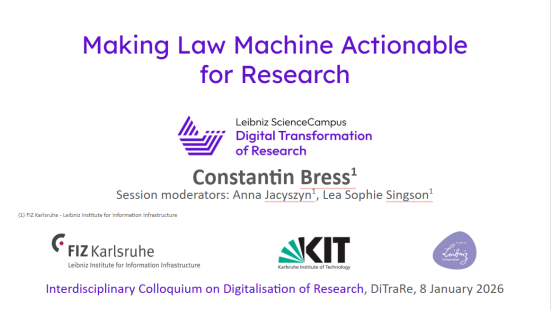
January Colloquium
TATuP Special topic
Call for Abstracts for the interdisciplinary TATuP Special topic in issue 36/1 (2027). „Generative AI at the workplace: Challenges and implications for knowledge-intensive work”. Please read the complete CfA online. Deadline for submitting your abstract: March 19, 2026
Artificial Intelligence in Cardiology
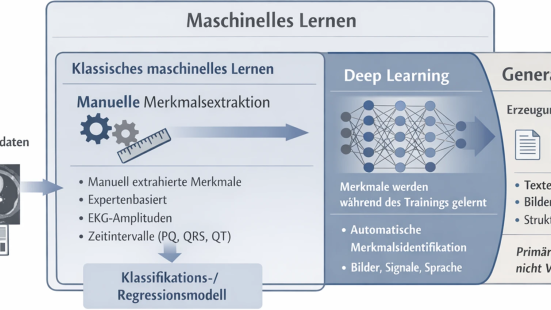
Axel Löwe published a review article on artificial intelligence in cardiovascular medicine. The paper outlines methodological foundations and highlights applications in imaging and ECG analysis, including deep learning for functional assessment and disease prediction. It also addresses generative AI, implementation challenges, and ethical considerations. The article is only available in German. (more)
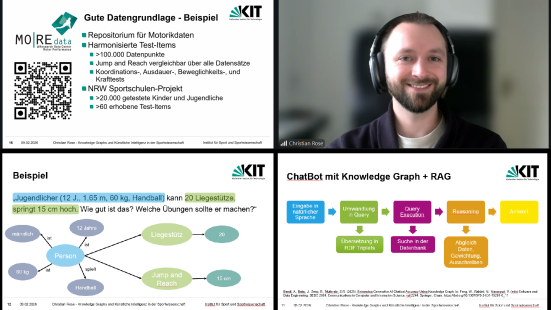
Presentation at the Love Data Week 2026
During the Love Data Week 2026, hosted by forschungsdaten.info, Christian Rose contributed a presentation on the use of knowledge graphs and artificial intelligence in sports science.
His talk highlighted current developments, practical applications, and future perspectives for data-driven research in this field.
The presentation slides are available on Zenodo
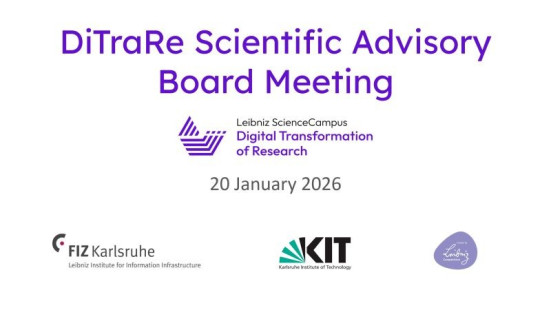
Scientific Advisory Board in 2026
At the end of January, we held our first meeting of the year with our Scientific Advisory Board, and it was once again very productive!
We would like to thank Gabriele Gramelsberger, Sonja Schimmler and Regine Stein for their valuable input, which will help us prepare for the upcoming funding phase this year.
The lively discussion focused on the opportunities and challenges of interdisciplinarity, our outreach activities, and the forward-looking research questions that we want and need to address. We look forward to incorporating these ideas and topics into our practical work. Thank you to all the SAB and project members involved!